Claude: A Closer Look at Anthropic's Innovative AI
Chatbot Claude by Anthropic is one of ChatGPT's main competitors. The company may not be as renowned as OpenAI, but it is successful and well-funded. Over the last few years, Amazon invested $4 billion in Anthropic, and in November 2024, they announced a new investment of another $4 billion, bringing the total to $8 billion. As for Claude, people praise the chatbot for its humanity, creativity, sensitivity, and emotional intelligence. In this article, we will look at the history of the Claude chatbot, its fundamental principles, advantages, and limitations.
Claude origins
Anthropic is co-founded by Dario Amodei and his sister Daniela Amodei. Before founding their company, they both worked at OpenAI: Dario was vice president of research and led the creation of influential models like GPT-2 and GPT-3, while Daniela was vice president of safety and policy.

Dario and Daniela Amodei
Why did Dario Amodei leave OpenAI? Some sources say that he departed over concerns that OpenAI increasingly prioritized anything but ethical artificial intelligence development. And here's what Dario himself says:
“There’s a lot of misinformation out there. People say we left because we didn’t like the deal with Microsoft. False.” The real reason for leaving, he said, is that “it is incredibly unproductive to try and argue with someone else’s vision.” So rather than staying at OpenAI, Amodei told himself, “Take some people you trust and go make your vision happen.”
So Dario, Daniela and a few other former OpenAI employees formed Anthropic in 2021 to realize their vision of artificial intelligence. In March 2023 they released the first version of the Claude language model. The name was notably inspired by Claude Shannon, an American mathematician, scientist, and inventor known as “the father of information theory” and “the father of the information age.”
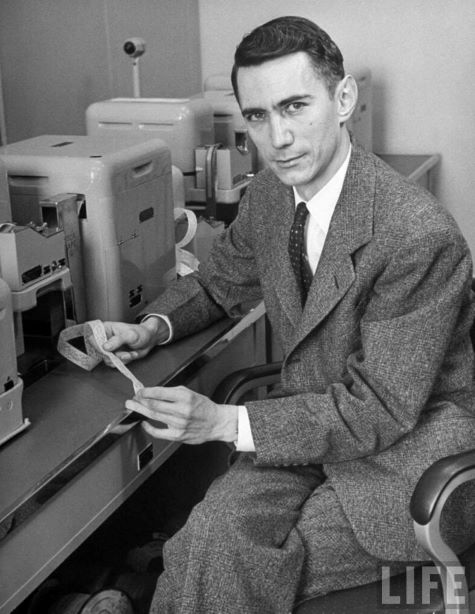
Claude Shannon
Claude's principles and values
The company's mission is to investigate the safety, inner workings, and societal impact of AI models, ensuring that artificial intelligence has a positive impact on society as it becomes more advanced and capable.
Dario Amodei:
We've tried to design Claude with safety and controllability in mind from the beginning. A lot of our early customers have been enterprises that care a lot about, you know, making sure that the model doesn't do anything unpredictable. Or make facts up. One of the big ideas behind Claude is something called constitutional AI. Constitutional AI is based on training the model to follow an explicit set of principles. So you can be more transparent about what the model is doing. And this makes it easier to control the model and make it safe.
What is Constitutional AI? It is a method for training helpful, honest and harmless AI assistant through self-improvement without any human labels identifying harmful outputs.
This process involves two phases a supervised learning phase and a reinforcement learning phase:
- In the supervised phase, an initial model is sampled, self-critiques and revisions are generated, and the original model is fine-tuned on the revised responses.
- In the reinforcement learning phase, samples from the fine-tuned model are evaluated, and a preference model is trained from the dataset of AI preferences. The preference model is then used as the reward signal to train the AI assistant.
As can be seen in the graph, this approach gives better results compared to the conventional Reinforcement learning from human feedback (RLFH) method used to train other language models. That means Claude is less likely to say harmful things and misbehave less frequently than other chatbots.
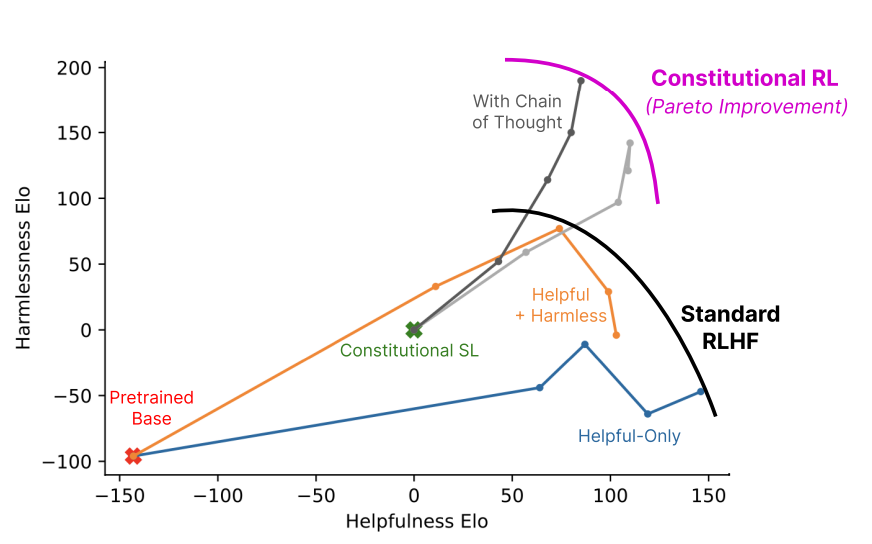
Constitutional RL vs Standard RLHF
The only human oversight is provided through a list of rules or principles borrowed from various sources, such as the UN Declaration of Human Rights or Sparrow Principles from DeepMind. You can learn more about it here: https://www.anthropic.com/news/claudes-constitution
Claude's features and current models
Typically, artificial intelligence systems are judged based on how they perform on benchmark evaluations — standardized tests given to models to determine how capable they are at coding, answering math questions, or other tasks. By those metrics, the latest versions of Claude are roughly comparable to the most powerful models from OpenAI and Google.
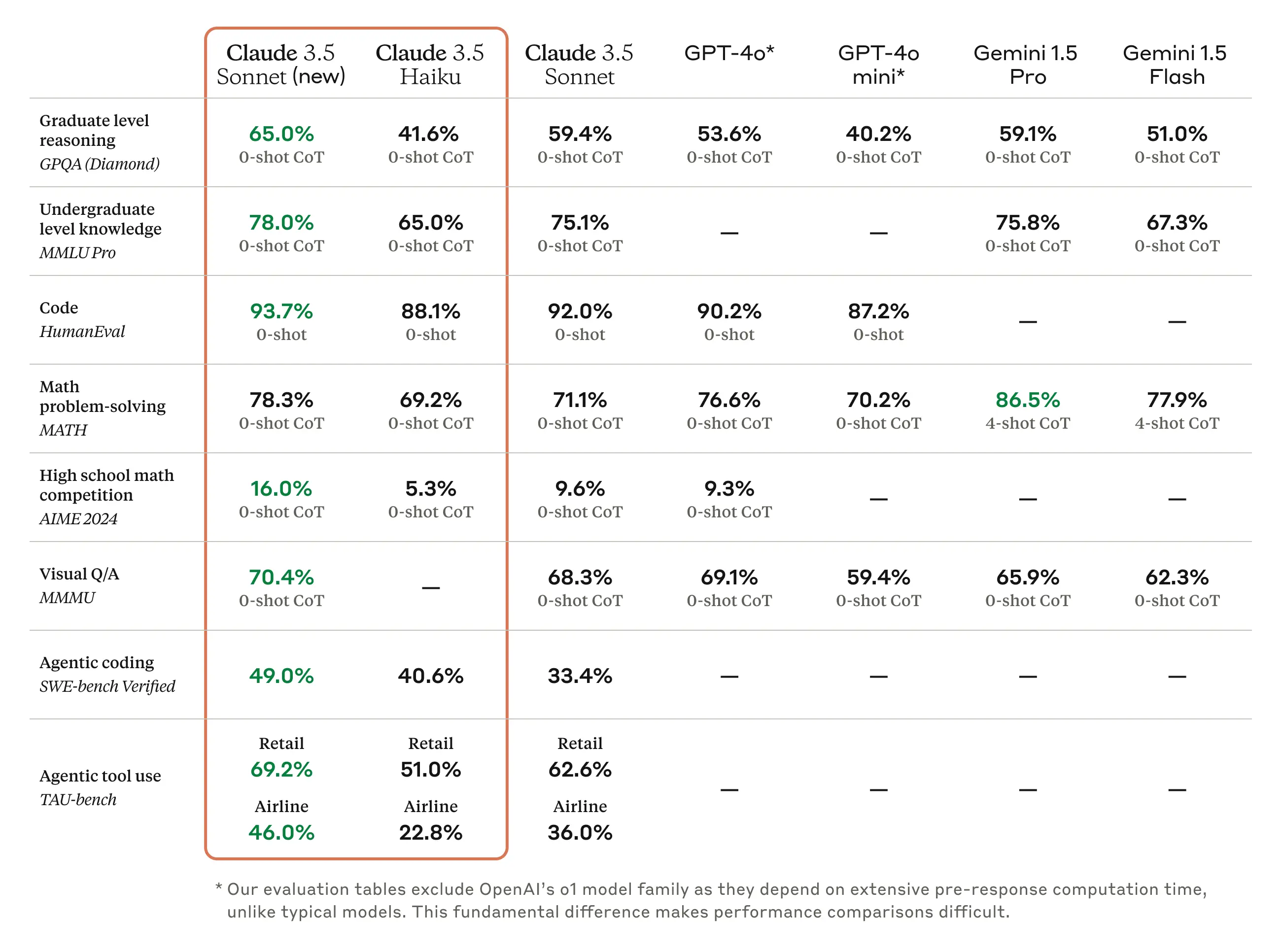
Claude 3.5 vs other models in benchmarks
But Claude’s killer feature — its emotional intelligence — isn’t something that can easily be measured. People say that Claude just feels different. More creative and empathetic. More insightful and less gratingly robotic. Claude’s outputs, they say, are like the responses a smart, attentive human would give, and less like the generic prose generated by other chatbots.
The developers highlight the following positive aspects of the chatbot:
- Claude is secure because it offers accessibility through AWS and GCP, SOC 2 Type II certification, and HIPAA compliance options, adhering to rigorous security practices.
- Claude is trustworthy because it combines best-in-class jailbreak resistance and misuse prevention.
- Claude is reliable since it boasts very low hallucination rates and very high accuracy, even when working with long documents.
Comparison of current Claude models:
| Model | Claude 3.5 Sonnet | Claude 3.5 Haiku | Claude 3 Opus | Claude 3 Sonnet | Claude 3 Haiku |
| Description | Most intelligent model | Fastest model | Powerful model for highly complex tasks | Balance of intelligence and speed | Fastest and most compact model for near-instant responsiveness |
| Strengths | Highest level of intelligence and capability | Intelligence at blazing speeds | Top-level intelligence, fluency, and understanding | Strong utility, balanced for scaled deployments | Quick and accurate targeted performance |
| Multilingual | Yes | Yes | Yes | Yes | Yes |
| Vision | Yes | No | Yes | Yes | Yes |
| Comparative latency | Fast | Fastest | Moderately fast | Fast | Fastest |
| Context window | 200K tokens | 200K tokens | 200K tokens | 200K tokens | 200K tokens |
| Max output | 8192 tokens | 8192 tokens | 4096 tokens | 4096 tokens | 4096 tokens |
| Training data cut-off | April 2024 | July 2024 | August 2023 | August 2023 | August 2023 |
200K tokens roughly correspond to 150K English words or 680K unicode characters.
8192 tokens roughly correspond to 6200 English words or 12-14 single spaced pages.
4096 tokens roughly correspond to 3100 English words or 6-7 single spaced pages.
Two of the newest models are called Claude 3.5 Sonnet and Claude 3.5 Haiku.
Claude 3.5 Sonnet is the most powerful and intelligent model. It can understand nuanced instructions and context, recognize and correct its own mistakes, extract information from visuals like charts, graphs, and complex diagrams. Enhanced reasoning capabilities, a large context window, low rates of hallucination, and a warm, human-like tone on top everything, make Claude 3.5 Sonnet an ideal chatbot for answering questions, analyzing documents and knowledge bases.
Claude 3.5 Haiku is the fastest model. It truly shines wherever you need rapid response times, whether in customer service, social platforms, online communities, e-commerce, or education. Claude 3.5 Haiku provides fast, accurate code suggestions to speed up development. It's perfect for software teams wanting to simplify coding and increase productivity. Claude 3.5 Haiku only supports text input, meaning it cannot process visual data.
What Claude can do: its strengths and weaknesses
Right-sized for any task, the Claude family of models offers the best combination of speed and performance. Claude can perform complex cognitive tasks and routine data processing with equal ease. From sophisticated language understanding to rapid number crunching, the Claude models are your go-to assistants for a wide range of professional and personal needs:
- Transcribe and analyze static images, from handwritten notes and graphs, to photographs.
- Translate between various languages in real-time, practice grammar, and create multi-lingual content.
- Create websites in HTML and CSS, turn images into structured JSON data, and debug complex code bases.
- Engage in natural conversations and provide detailed, easily understood answers.
- Due to its huge context window, Claude can digest larger pieces of data, analyzing a whole book or critiquing a long essay in one go.
Supported document types:
- DOCX
- CSV
- TXT
- HTML
- ODT
- RTF
- EPUB
- JSON
File Limits:
- 30MB per file
- Up to 5 files per chat
Technical limitations: Claude cannot search for information on the Internet, generate images, no voice mode.
Claude understands jokes, puns, apologies, and compliments. The chatbot’s exceptional writing skills allow it to craft emotional, human-like stories.
However, some people complain that the chatbot has become worse at writing, and the reason for this is Claude's character.
Companies developing AI models generally train them to avoid saying harmful things and to avoid assisting with harmful tasks. The goal of this is to train models to behave in ways that are "harmless". But when we think of the character of those we find genuinely admirable, we don’t just think of harm avoidance. We think about those who are curious about the world, who strive to tell the truth without being unkind, and who are able to see many sides of an issue without becoming overconfident or overly cautious in their views. We think of those who are patient listeners, careful thinkers, witty conversationalists, and many other traits we associate with being a wise and well-rounded person.
At times, Claude acts timidly, refusing to answer any sensitive questions. The developers are very proud of the fact that it is difficult to extract illegal information from the bot, such as how to counterfeit money or how to hide from the police. But sometimes Claude turns on self-censorship and lectures in response to completely harmless requests. For example, the bot refuses to write a funny story about being fired because “doesn’t want to hurt anyone’s feelings with inappropriate humor”; or can cite copyright infringement if asked to parody a famous character.
Reddit users make fun of Claude:

Me: Hi; Claude: starts apologizing
But there's a good side to this sensitivity - Anthropic is very protective of your privacy:
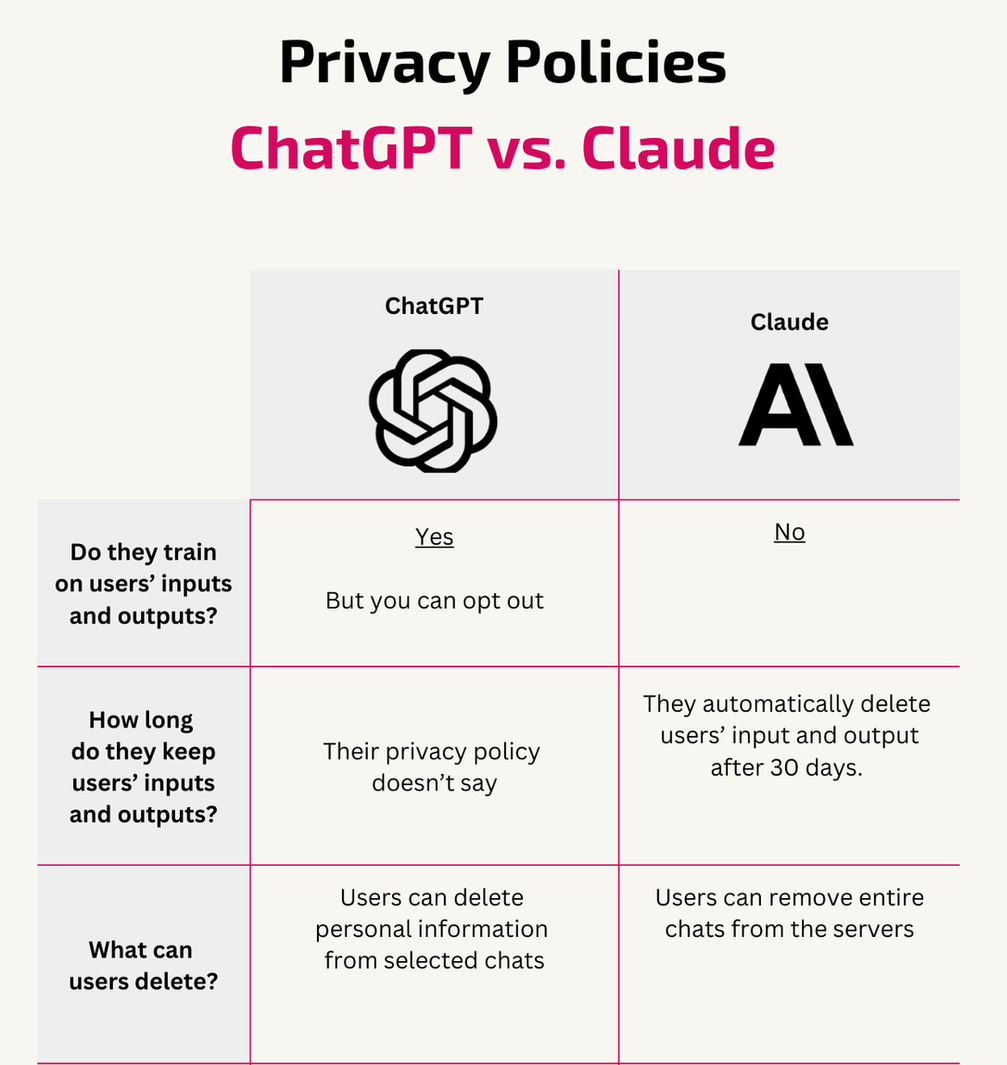
Anthropic don’t train its models on your data. They automatically delete all your information after 30 days, and you can remove entire chats from their servers any time you want.
How people use Claude
Claude can thoroughly review and comprehend lengthy legal documents, such as contracts or case files. And by taking on this time-consuming task, Claude helps lawyers save their valuable time for higher-level work. That’s why legal tech startup Robin AI uses Claude to analyze legal paperwork.
Scribd, Inc. uses Claude to generate high-quality metadata for millions of user-uploaded documents, improving content discoverability and driving user engagement across its global platforms.
- Helped address 70% of user-uploaded content that lacked quality metadata.
- Richer content descriptions significantly increased user signups and subscriptions.
- Scaled to process over 100 million documents.
Newfront, a modern insurance platform, uses Claude to automate tedious insurance tasks and provide instant support, making insurance more accessible and efficient for everyone.
With Claude, Newfront:
- Saves HR teams one month per year and delivers 24/7 personalized support for employees.
- Reduces document processing costs by 60%.
- Provides instant contract reviews for legal teams.
Zapia helps Latin American consumers discover products, make purchases, and get support through popular messaging apps like WhatsApp.
By using Claude, Zapia:
- Grew by 2.5 million users in their first year.
- Generated over 90% positive user feedback.
- Handles hundreds of thousands of messages per hour.
As you can see, Claude's versatility across industries highlights its commercial potential. Companies are deploying it for workflows from sales to software development. By automating repetitive tasks and assisting with content creation, Claude can boost productivity and free up human workers to focus on higher-value work.
Learn about more Claude’s customers and commercial use cases here: https://www.anthropic.com/customers
Statistics based on 1 million randomly selected chats:
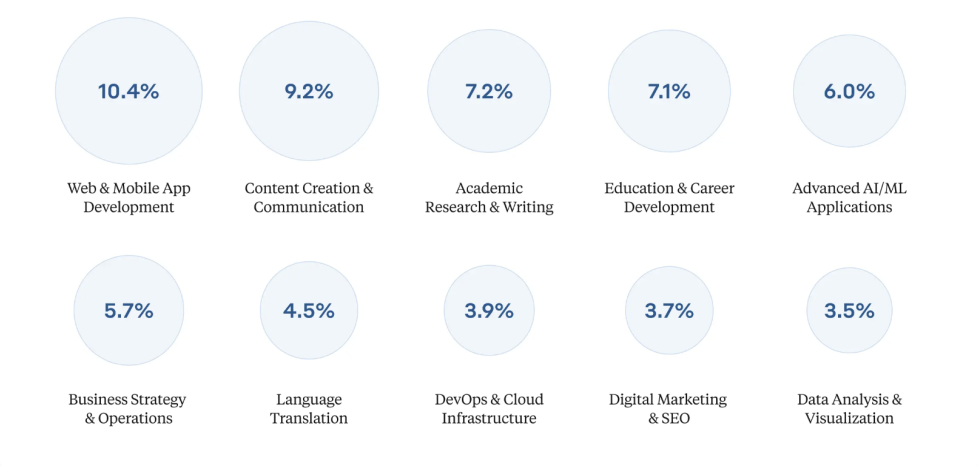
- 10.4% – Web & Mobile App Development
- 9.2% – Content Creation & Communication
- 7.2% – Academic Research & Writing
- 7.1% – Education & Career Development
- 6.0% – Advanced Artificial Intelligence / Machine Learning Applications
- 5.7% – Business Strategy & Operations
- 4.5% – Language Translation
- 3.9% – DevOps & Cloud Infrastructure
- 3.7% – Digital Marketing & SEO
- 3.5% – Data Analysis & Visualization
The data was collected by Clio (Claude Insights and Observations), a platform that provides an overview of AI usage patterns, revealing trends and behaviors without compromising individual privacy.
The wide variety of applications and the substantial usage rates across different categories highlight how AI-powered solutions are becoming increasingly common. This trend showcases the versatility of tools like Claude and reflects the growing integration of AI into our professional and personal lives.