Alternatives to ChatGPT
ChatGPT is on everyone's lips. It is the most popular and widely used chatbot, and ChatGPT’s parent company, OpenAI, is by far the best funded machine learning AI platform, which has raised over $13 billion in funding (its nearest competitor, Scale AI, has raised “only” $600 million to date).
So, are there any alternatives to ChatGPT?
What are the main competitors to ChatGPT?
The second most used chatbot in the market (second to ChatGPT, of course) is Google Bard. It was launched on March 21, 2023, and is expected to surpass 1 billion users by the end of 2023.
Let’s compare ChatGPT and Google Bard side by side.
| ChatGPT | Google Bard | |
| Active users | Over 100 million | 30 million |
| Official website visits (monthly) | 1 billion | 140 million |
| Language model parameters | 100 trillion | 137 billion |
| Supported languages | 85-106* (per different sources) | 46 (per Google) |
| Geographical availability | 188 countries and regions | Over 230 countries and territories |
*106 is an impressive number, but remember that ChatGPT knows some languages much better than others.
Since neither ChatGPT nor Google Bard are available in China, other chatbots will take their place:
- Ernie by Baidu (ranked first in popularity on Apple’s app store in China),
- Tongyi Qianwen by Alibaba will be integrated into all of the company's apps soon.
In other parts of the world, several different chatbot apps are ready to compete for market share:
- Ajax by Apple,
- LLaMa 2 by Meta,
- Claude 2 by Anthropic.
Amazon is about to invest $4 billion in the Anthropic's product. Access to Claude 2 is currently by invitation only.
| GPT-4 | Claude 2 | |
| Key Strengths | Text generation, coding, problem solving | Mathematics, safety, ethics |
| Use cases | ChatGPT, Copilot, marketing content | Math, legal analysis, content moderation |
| Context length | 128 000 tokens (1000 tokens is about 750 words) | 100 000 tokens |
| Availability | Free basic version, $20/month ChatGPT Plus | $20/month Claude Chat Pro |
LLaMa 2 is an open-source large language model, free for research and commercial use. It shows excellent results compared to OpenAI’s GPT-4.
| LLaMa 2 | GPT-4 | |
| Spotting factual inconsistencies in summarized news reports | 81.7% accuracy | 85.5% accuracy |
| LSAT and SAT exams | 80-100% | 80-100% |
| Image classification on ImageNet | 89.6% (top-1 accuracy) | 89.6% (top-1 accuracy) |
Ajax, also referred to as “Apple GPT”, should be more powerful than GPT-3.5. However, its true potential remains uncertain as Apple has yet to make the product available. According to Apple analyst Ming-Chi Kuo, “Apple GPT” is not coming in 2024.
How big is the artificial intelligence market?
The AI market is huge, its overall value is $150 billion dollars, and is projected to hit $1.5 trillion by 2030.
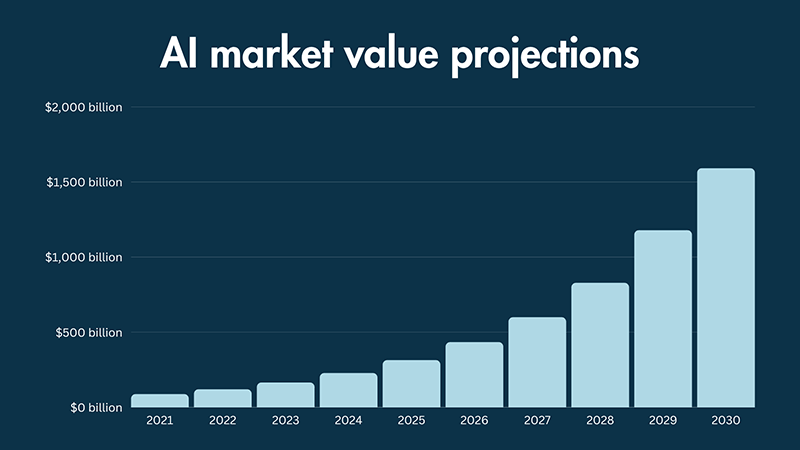
Artificial intelligence market projections
Global corporate investment in AI was almost $200 billion in the last couple of years and continues to grow.
The surging demand for generative AI products has the potential to contribute approximately $280 billion in new software revenue. This growth will be driven by specialized assistants, innovative infrastructure products, and coding accelerator copilots. Leading companies in this space, including Amazon Web Services, Microsoft, Google, and Nvidia, are expected to be the primary beneficiaries as enterprises increasingly migrate their workloads to the public cloud.
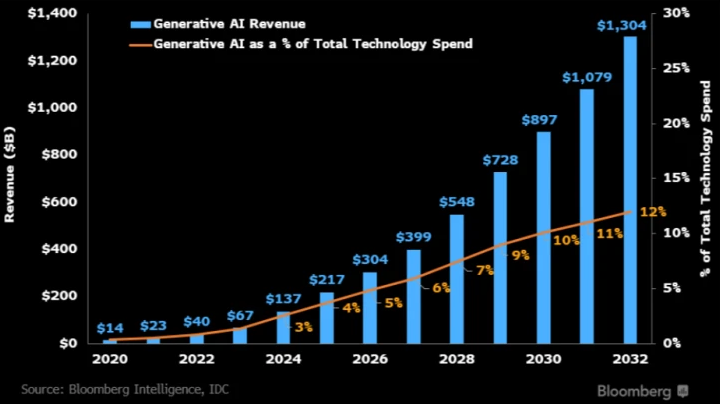
Revenue projections for the generative AI market
By 2032, generative AI is expected to significantly expand its impact, growing from less than 1% to 10% of the total market spending in IT hardware, software services, ad spending, and gaming. The primary drivers of this incremental revenue growth will be generative AI infrastructure as a service, projected to reach $247 billion by 2032, followed by digital ads powered by the technology, amounting to $192 billion, and specialized generative AI assistant software, estimated at $89 billion. On the hardware side, revenue growth will be driven by AI servers ($132 billion), AI storage ($93 billion), computer vision AI products ($61 billion), and conversational AI devices ($108 billion).
Who’s in the lead?
In terms of popularity and funding ChatGPT by OpenAI is the unanimous number 1 in the world. It can be considered the best chatbot at the moment and the most promising one at the same time.
Each large language model (LLM) has its own strengths and weaknesses.
| LLM | Strengths | Weaknesses |
| Claude 2 | Comprehending complex queries, mathematics, code writing | Creative text generation |
| LLaMa 2 | Remarkable multilingual capabilities | Lacks in coding proficiency |
| GPT-4 | Answering queries, realistic and creative text generation | Can be overly cautious at times, avoiding direct answers* |
*This is a countermeasure against hallucinations. Quite effective, considering that in tests conducted by the LLM benchmarking service “Arthur” GPT-4 was the only one of the three models that gave more correct answers than hallucinations.
GPT-4, the newest model used in ChatGPT, is the most versatile choice for most tasks. Other models and chatbots may excel in some areas, while ChatGPT-4 is good at everything. That’s what makes it stand out.